Pronunciation Lab
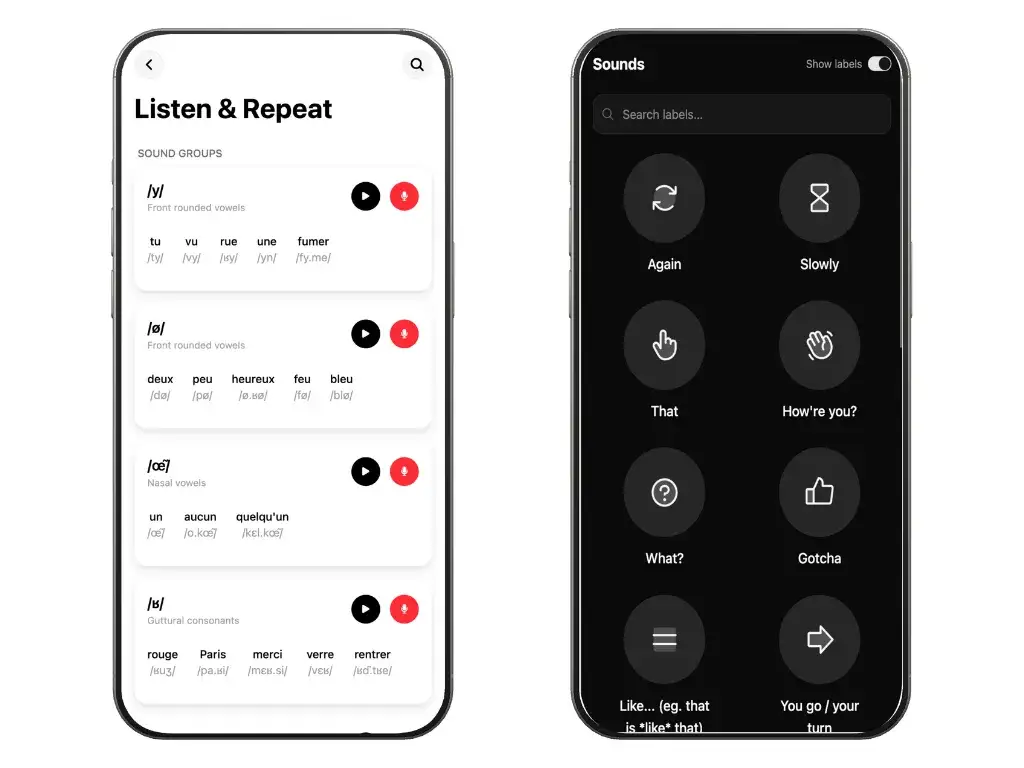
Table of Contents
Advanced Speakers: Pronunciation Refinement
Left App
Dedicated to sounds which are known problems for native English speakers, this app groups sounds, first by type (e.g. “Front rounded vowels” which may contain multiple IPA characters) and then by IPA character (e.g. “ø” of which there is necessarily only one). For each IPA character, there is a recording of a native speaker, providing a “base-truth” of a given practice text. Then the student would be able to record themselves and listen back to self-evaluate.
Unlike other shadowing techniques which focus on phrase pronunciation, this app would focus on sound pronunciation. This is helpful because it catches edge cases which are not currently being accommodated. We can imagine a student getting 95% of multiple phrases correct, but the remaining 5% are consistently the same sound. Such a student may be able to attain a very high level in a language while still retaining gaps in their ability to pronounce the sounds of a language. Television, music, and daily life in the target language are not enough if the inability to pronounce certain sounds has proved persistent. This has been my experience after spending several years in France and the experience of my roommate after her undergrad in Korea.
I’ve heard of the shift in language instruction toward accepting L2 accents. This is great news, and this app does not seek to regress that development. Instead, it is best considered as a precise intervention for students having hard-to-solve pronunciation problems that exceed the acceptable margins of an L2 accent and instead are truly difficult to understand. The value of this would be even more obvious for advanced speakers where their pronunciation difficulties have proved resilient to a great deal of speaking and listening.
Beginner Speakers: Avoiding French-Text Encounters
Right App
This app is a partial and experimental response to the question: what shape might language instruction take communication was treated as primordial?
It depends on two core beliefs:
- Seeing how a word is spelled is more hurtful than helpful, given the many letters that are always or become conditionally ‘silent’ in French. Any native anglophone is liable to get tripped up by looking at the letters of a word and then being subconciously forced to wrangle with their existing mental model of pronunciation. By not showing new learners the spelling of words, we can focus on getting them speaking and prevent them from holding themselves back by getting caught in the woodwork of their pre-existing text-to-sound mental modal.
- Traditional language education’s initial focus on learning how to present one’s self, count, use colors, and identify classroom objects does not lend itself to real communication. Not only am I learning a language to communicate with people who speak that language, but indeed native speakers are best positioned to continue to my growth in a language. It’s for this reason that it’s essential to get students off learning declarative phrases and on to learning interrogative ones. I’ve already written a little about the topic of which questions are likely more helpful here.
Ongoing Thoughts
Each of these needs some more attention before they could be deployed in a real world setting, but if either are research interests of yours, feel free to get in touch.